
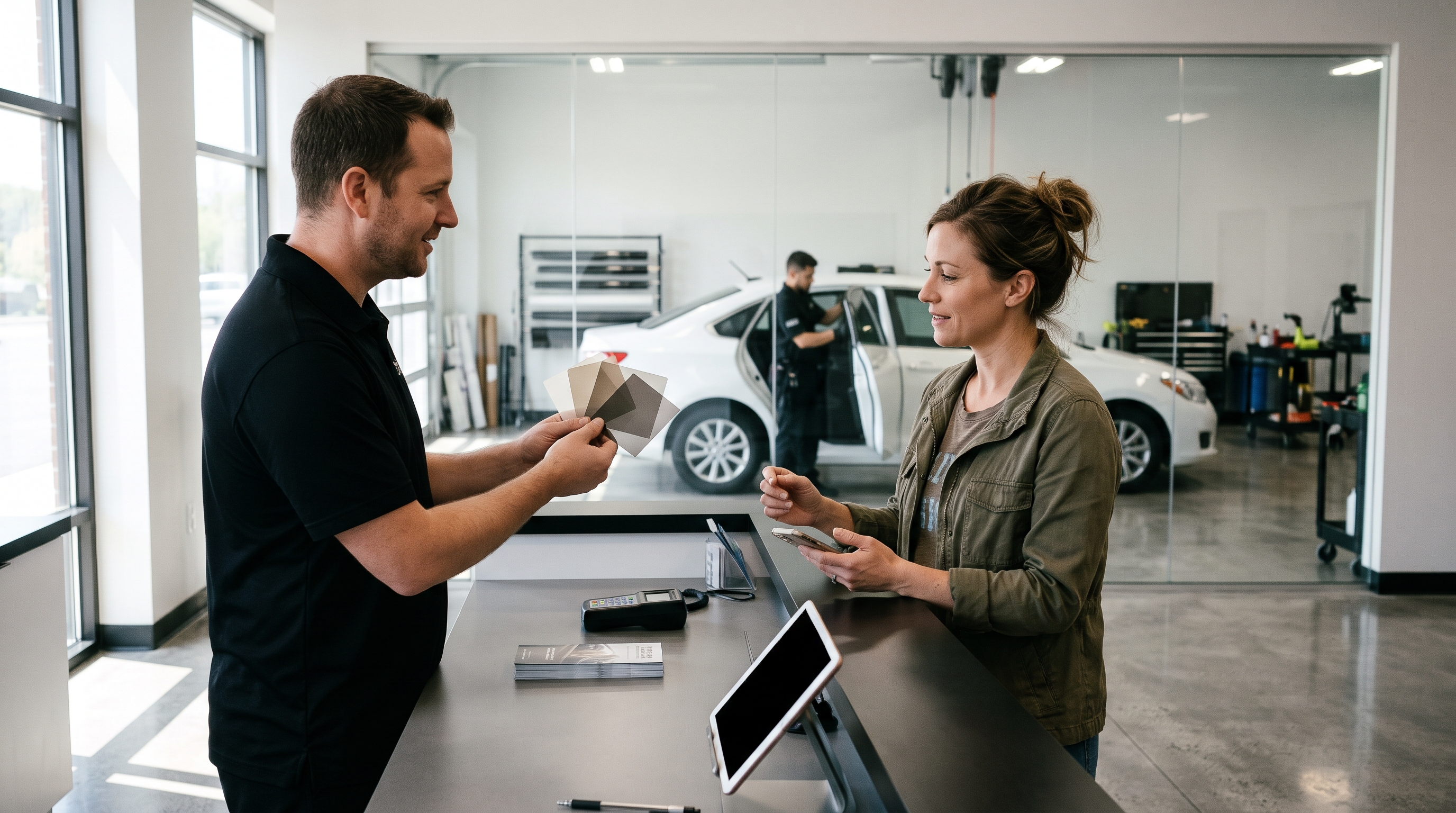
How much does window tinting cost? The short answer
Tinting all the side windows and the rear glass on a sedan costs about $150 to $300 with basic dyed film and $350 to $900 with ceramic. SUVs and trucks cost more because they have more glass. The film you choose moves the price more than anything else, followed by your vehicle and where you live.
What sets your price:
- Film type: Dyed is the cheapest, carbon sits in the middle, and ceramic costs the most.
- Vehicle size: More glass and curved rear windows take more film and labor.
- Coverage: Windshields, sunroofs, and removing old tint are priced separately.
- Location: The same job can cost twice as much in one state as in another.
- Brand and warranty: Name-brand film from an authorized dealer costs more and usually carries a lifetime warranty.
Window tint prices by vehicle and film type
These ranges come from installer price guides published in 2025 and 2026. They cover the side windows and the rear glass.
| Vehicle | Dyed Film | Carbon Film | Ceramic Film |
|---|---|---|---|
| Coupe or sedan | $120–$300 | $200–$500 | $350–$900 |
| SUV or pickup truck | $180–$400 | $320–$600 | $450–$1,200 |
Real quotes people shared on r/WindowTint fall inside those ranges. A North Carolina owner paid $250 for LLumar ceramic on a 2024 Accord. A Texas driver paid $380 for XPEL XR ceramic on the doors and rear glass. Another paid $300 for basic film and was quoted $450 for ceramic at the same shop.
Partial jobs and add-ons
Not every job is a full car. Typical prices for the extras:
| Service | Typical Cost | Notes |
|---|---|---|
| Front two windows only | $50–$250 | Common for matching factory-tinted rear glass |
| Windshield strip | $50–$110 | Usually down to the AS-1 line |
| Full windshield | $100–$300 | Clear or very light films only in most states |
| Sunroof | $60–$150 | Panoramic roofs cost more |
| Old tint removal, full car | $150–$300 | The rear window alone runs $100–$175 |
Removal prices come from a Tint Academy pricing guide. Old dyed film that has gone purple and bubbly is the slowest to remove, because the adhesive breaks down and stays on the glass.
Why prices vary so much by location
"What is $400 in one state is $800 in another" is the most common answer when someone asks about prices on Reddit, and it holds up. Labor rates, shop rent, and local competition all feed into the quote. One commenter noted that prices are usually lower in cities, where more shops compete for the same customers. One Pennsylvania driver paid $1,100 for full ceramic on an SUV, including the windshield and a panoramic roof, in a rural area.
The best way to know your local price is to get three quotes for the same film on the same car.
Dyed vs. carbon vs. ceramic: cost per year
Ceramic costs two to three times more than dyed film up front, but it lasts much longer. Installer guides put dyed film at 2 to 5 years before it fades or bubbles, carbon at 5 to 10 years, and ceramic at 10 years or more.
| Film Type | Example Price (Sedan) | Expected Life | Cost per Year |
|---|---|---|---|
| Dyed | $200 | About 3 years | About $67 |
| Carbon | $350 | About 7 years | About $50 |
| Ceramic | $500 | About 10 years | About $50 |
Ceramic also blocks far more heat at the same shade, because it rejects infrared light instead of just darkening the glass. If you plan to keep the car for more than a few years, carbon or ceramic is usually the cheaper choice over time.
What illegal tint really costs
A cheap, dark tint can end up being the most expensive option. A first tint ticket is often a fix-it ticket of about $25, then about $100 for a first citation and over $200 for a second, according to FindLaw. Some states are much stricter. New Jersey can charge up to $1,000 for a first offense, and Georgia treats illegal tint as a misdemeanor with a fine of up to $1,000.
The ticket is only part of it. Here is what a typical illegal job can cost:
- Dark film installed: $300
- First citation: $100
- Removal of the illegal film: $150–$300
- New legal film: $300
That adds up to $850 or more, almost three times what a legal job would have cost in the first place. Check the limits for your state on our 50-State Chart before you choose a shade. If you need darker tint for a medical reason, read our guide on getting a medical window tint exemption first.
How to compare quotes
A low quote is only a good deal if it's for the same thing. Before you book, ask each shop:
- Which brand and film line? "Ceramic" can mean very different products. Get the exact name, like LLumar IRX or XPEL XR.
- Is the shop an authorized dealer? Manufacturer warranties usually require one.
- What does the warranty cover? Look for bubbling, peeling, fading, and color change, and ask whether it's a lifetime warranty.
- Is removal of old tint included? If your car has old film, it often isn't.
- Will they meter the finished windows? A shop that checks the final VLT is less likely to leave you with an illegal job.
Home and office window tint cost
Residential film is priced by the square foot, not by the window. Professionally installed film typically costs $7 to $24 per square foot, with most premium installs landing around $10 to $12, according to WindowFilm.com. Thumbtack puts the national average for a home or office project at $365 to $952.
Large picture windows, high glass that needs a ladder, and ceramic or security films push the price up. Unlike cars, homes have no VLT limits, but some homeowner associations set rules about reflective film.
Frequently asked questions
How much should tint all around cost?
For a sedan, expect $150 to $300 with dyed film and $350 to $900 with ceramic for the sides and rear glass. Add $50 to $110 for a windshield strip. SUVs and trucks cost more.
Is 35% or 20% tint darker?
20% is darker. The number is the percentage of light the film lets through (VLT), so a lower number means darker glass. A 20% film blocks 80% of visible light, and a 35% film blocks 65%. Many states don't allow 20% on the front side windows.
Is it worth it to tint your car windows?
For most drivers, yes. Quality film blocks over 99% of UV light, cuts heat and glare, and protects the dashboard and seats from fading. Ceramic gives the most heat rejection, and it's the best value if you keep the car for several years.
How long will window tinting last?
It depends on the film. Dyed film lasts about 2 to 5 years, carbon 5 to 10 years, and ceramic 10 years or more. Professional installation and a manufacturer warranty make a long life more likely.
Sources
- How much does it usually cost to get tint installed, r/WindowTint
- Window Tint Cost Near Me: 2025 Pricing Guide Florida, Winter Park Tint
- Car Window Tinting Cost Guide, J3ss-InTime Window Films
- How Much Should You Charge for Window Tint Removal?, Tint Academy
- Window Tint Laws: The Basics, FindLaw
- How Much You Could Get Fined for Illegal Window Tint, Jalopnik
- Window Film Cost Guide, WindowFilm.com
- Window Tinting Cost Guide, Thumbtack
Need a Verified Window Tint Pro in Your City?
Avoid non-compliant film and costly citations. Search our nationwide directory of licensed, highly-rated automotive window tint specialists with verified customer reviews and warranty-backed installations.
Find Tint Shops Near You →