
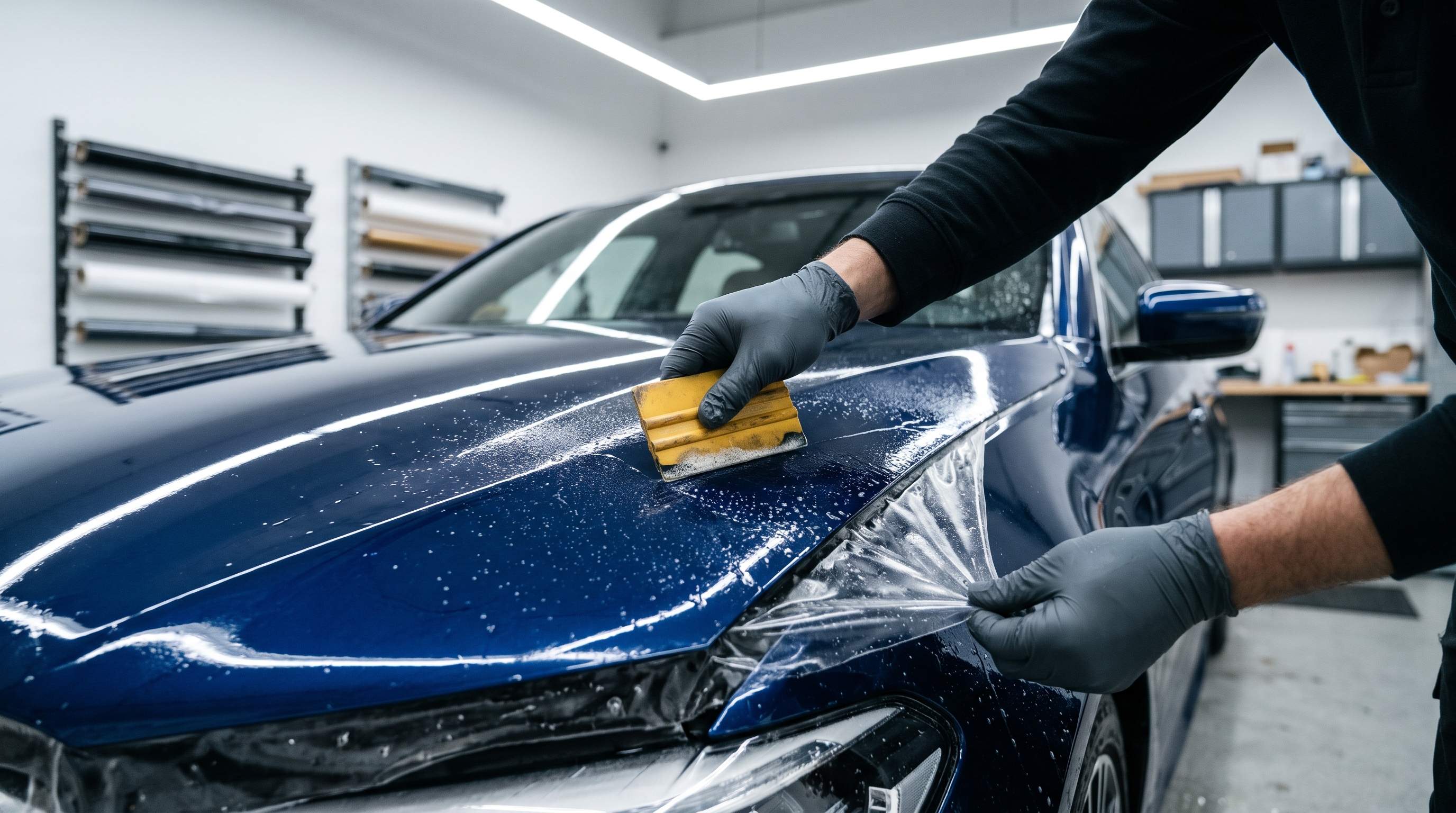
What is PPF on a car? The short answer
PPF stands for paint protection film. It's a clear, flexible sheet of urethane that a shop applies over your car's paint so rocks, gravel, bug splatter and light scratches hit the film instead of the paint. You'll also hear it called a clear bra or clear film. Most premium films are about 8 mils thick (0.008 inch), around twice as thick as a typical vinyl wrap, and many have a top coat that heals light scratches with heat.
Think of it as a screen protector for your paint. It isn't indestructible. It's a sacrificial layer that can be replaced panel by panel, while the factory paint underneath stays untouched.
PPF in 30 seconds:
- What it is: A clear thermoplastic urethane film, usually about 8 mils thick.
- What it stops: Rock chips, road rash, light scratches, bug and bird etching, UV fading.
- What it doesn't stop: Deep gouges, hard impacts, and dents.
- What it costs: About $500 to $1,500 for a partial front, and $2,000 to $8,000 or more for the whole car.
- How long it lasts: Most good films carry a 10-year warranty, and 5 to 10 years of real life is a fair expectation.
Where PPF came from
Paint protection film started as a military product. During the Vietnam War, flying debris kept damaging helicopter rotor blades, and the US military asked 3M for a light, clear layer that could take the hits instead. That's where the industry nickname "helicopter tape" comes from, according to Wikipedia's PPF entry. Race teams adopted it next, and it later moved to street cars. Early films were thick and hard to stretch over curves. Modern films are thinner, clearer and far easier to wrap around bumpers and mirrors.
How paint protection film works
A modern PPF is built in layers, each with a job:
| Layer | What it does |
|---|---|
| Top coat | A clear, often hydrophobic layer that resists stains and, on most premium films, heals light scratches with heat |
| Urethane body | The thick, stretchy layer that absorbs and spreads out the energy of a rock strike |
| Adhesive | A pressure-sensitive glue designed to hold firmly but release from factory paint |
| Release liner | A backing sheet that's peeled off during installation and thrown away |
When a stone hits the film, the urethane flexes and spreads the impact so it doesn't crack the clear coat underneath. Avery Dennison describes it as absorbing and dispersing the energy of impacts before they reach the paint.
What "self-healing" really means
Self-healing is the feature most people ask about, and it's real but limited. The top coat can flow back into shape when it warms up, so swirl marks and light scratches disappear in the sun, with warm water, or with a heat gun. A scratch that cuts through the top coat into the urethane won't heal. As the RAC puts it, deeper scratches still break through the film, and that panel then needs new film.
How thick is PPF?
Thickness is measured in mils, or thousandths of an inch. Thicker film absorbs more, but it's harder to stretch around tight curves and takes more labor to install.
| Product | Thickness | Typical use |
|---|---|---|
| Color-change vinyl wrap | 2 to 4.5 mils | Looks only, with minimal protection (Edmunds) |
| Standard premium PPF | About 8 mils | Daily drivers. Examples include 3M Scotchgard Pro Series and XPEL Ultimate Plus, both 8 mils |
| Heavy-duty PPF | About 10 mils | Off-road trucks, gravel roads, work sites (Edmunds) |
For most commuters, an 8-mil film from a major brand is the right choice. Go thicker only if you regularly drive on gravel or through brush.
Coverage options and what PPF costs
You don't have to wrap the whole car. Shops sell PPF in packages, and coverage is the biggest driver of price.
| Package | What's covered | Typical cost |
|---|---|---|
| Partial front | Front bumper, the first 18 to 24 inches of the hood and fenders, mirrors | $500–$1,500 |
| Full front | Whole bumper, full hood, full fenders, mirrors, often headlights | Between partial and full body, depending on the car |
| Track pack | Full front plus rocker panels, rear bumper top and other high-impact areas | Often $2,000–$3,000 or more |
| Full body | Every painted panel | $2,000–$8,000+ |
These ranges come from Pure PPF (partial front $500 to $1,500, full body $2,000 to $7,000 or more), Edmunds (up to about $8,000), and owners on r/cars, where quotes ran $2,000 to $3,000 for high-wear areas and up to $10,000 for a full wrap. One owner paid $2,900 to cover the whole nose and lower panels of a Jeep Trackhawk. Another paid $6,000 for full coverage on a Porsche 718.
Three things push a quote up: a big or curvy vehicle, a premium or colored film, and a shop that removes trim, lights and badges so it can wrap the film around the edges. That last one costs more but looks much better, which we cover below.
How long does PPF last?
A quality film should last 5 to 10 years, and often longer. The RAC says it normally won't need replacing for five to ten years. Edmunds says most people can expect at least a decade, and up to 15 years on a garaged car with a ceramic coating on top.
The warranties tell a similar story. 3M backs its Scotchgard Pro Series for 10 years against yellowing, bubbling and cracking when a 3M certified installer applies it. XPEL warranties Ultimate Plus for 10 years against yellowing, cracking, blistering and delaminating. Read the exclusions, though. 3M's warranty doesn't cover paint that pulls up when the film is removed, and both warranties depend on a certified installer.
What shortens the life of a film:
- Sun: A car parked outside in Arizona ages the film faster than one in a garage in Ohio.
- Cheap or old film: Low-end films are the ones that yellow and crack. An industry commenter on r/cars said films from 2012 and earlier tended to yellow around the 10-year mark.
- Neglect: Bird droppings and bug guts left to bake will stain the top coat.
- Pressure washers: A wand held close to an edge can lift the film.
The pros of PPF
- It actually stops rock chips. This is the one thing no wax or coating can do. One r/cars owner put it plainly: after a year, their unprotected Golf R was covered in chips, while their wrapped Supra looked nearly perfect after 35,000 miles and several track days.
- Light scratches heal themselves. Swirls from washing and fingernail marks around door handles fade with heat.
- It protects against etching. Bird droppings, tree sap, bug splatter and road salt hit the film first.
- It blocks UV. The paint underneath doesn't fade.
- It's removable. A good film comes off factory paint cleanly, leaving the original finish underneath.
- Damage is fixed panel by panel. If a section gets torn, the shop replaces the film on that panel instead of repainting.
- It can help resale on valuable cars. On luxury, sports and collectible cars, original, chip-free paint matters to buyers. The RAC lists preserved resale value as a benefit.
The cons of PPF (what most brand pages leave out)
Most of the pages ranking for this question are written by film makers and installers. Here's the honest list of downsides:
- It's expensive. Full coverage can cost several thousand dollars, and on regular cars you won't get that money back at resale. As one r/cars commenter noted, original paint rarely changes the value of a mass-market car.
- Edges can show. A pre-cut kit stops a few millimeters short of each panel edge. Dirt can collect along that line, and on dark paint you may see it.
- Partial coverage can leave uneven paint. If only the front is wrapped, years later the protected paint can look newer than the unprotected paint next to it.
- Bad installs cause real damage. An inexperienced installer cutting film on the car can slice into the clear coat. Poor fitting also causes bubbling and peeling, which the RAC flags as a resale problem.
- Cheap films yellow. Premium films resist it and warranty it, but bargain film can discolor in a few years.
- Removal can pull paint. Factory paint is usually fine. Resprayed panels or paint with existing chips can lift when the film comes off, and that's typically excluded from warranties.
- It doesn't stop everything. A big rock, a key or a fender bender can still damage the paint. One owner on r/cars covered most of a Mustang GT350 and still got chips.
PPF vs. ceramic coating vs. vinyl wrap vs. wax
These products are often confused. They do very different things.
| PPF | Ceramic coating | Vinyl wrap | Wax or sealant | |
|---|---|---|---|---|
| What it is | Thick urethane film | Thin liquid coating that cures on the paint | Thin colored vinyl film | Liquid or paste layer |
| Stops rock chips | Yes | No | Barely | No |
| Heals light scratches | Yes, most premium films | No | No | No |
| Makes washing easier | Somewhat | Yes, very hydrophobic | Somewhat | Somewhat, briefly |
| Changes the look | Clear, matte or colored | Adds gloss | Any color or finish | Adds gloss |
| Typical life | 5–10+ years | 2–5 years | A few years | Weeks to months |
| Typical cost | $500–$8,000+ | $1,000–$3,000 (pro) | Varies widely | Under $100 DIY |
Lifespan and cost figures for ceramic come from the r/cars comparison thread, and vinyl thickness from Edmunds.
The quick rule: PPF is for impacts, ceramic coating is for easy cleaning and gloss, and vinyl is for changing the color. Many owners combine them, with PPF on the front end and a ceramic coating over the film and the rest of the car.
PPF vs. window tint
They're both films, and many tint shops install both, but they aren't interchangeable. Window tint is a thin film applied to the inside of the glass to cut heat and light, and how dark it can be is set by your state's law. PPF goes on the outside of painted panels and headlights, and it doesn't affect your visibility or your state's tint limits. If you're getting both done, ask the shop to quote them together. For tint pricing, see our window tint cost guide.
Is PPF worth it?
It depends mostly on what the car is worth and how you drive it. Edmunds suggests that on a car under about $30,000, PPF becomes less worthwhile because it eats a large share of the car's value.
PPF usually makes sense if:
- The car is new, expensive, or likely to become collectible.
- You drive a lot of highway miles, especially behind trucks or on gravel.
- The factory paint is soft and chips easily, something owners complain about on some models.
- You're leasing and want to avoid excess wear charges on the front end.
- You plan to keep the car for many years and want the original paint to stay perfect.
It's probably not worth it if:
- The car is older, inexpensive, or already chipped and resprayed.
- You mostly drive short trips in town.
- You'd rather pay for an occasional touch-up and polish. As some owners point out, a full PPF wrap can cost more than fixing the chips later.
A common middle ground is a partial or full front on a new car, plus a ceramic coating or a good spray sealant on the rest.
How to choose a PPF installer
Two shops can use the exact same roll of film and hand you very different cars. That's why the first thing to pin down is what you're actually buying. "Premium PPF" on a quote doesn't tell you much, so ask for the brand and the product line by name, such as XPEL Ultimate Plus or 3M Scotchgard Pro Series. Then ask whether the shop is certified by that brand. It matters more than it sounds, because both 3M and XPEL tie their 10-year warranties to professional installation, and a shop that isn't certified may leave you with no film warranty at all.
Next, ask how they install it. Most shops use pre-cut kits, which a plotter cuts from a template for your exact model. They're faster and cheaper, but the film usually stops a hair short of each panel edge, and that thin line is where dirt collects. A bulk install starts from a full sheet that the installer trims by hand and wraps around the edges, sometimes after taking off badges, lights and trim. It looks close to invisible when it's done well and lifts less over time, but it costs more and relies entirely on the person holding the knife. Which brings up the question worth asking out loud: do they ever cut on the car? A careful shop works from templates or uses a knifeless tape so a blade never touches your paint.
Finally, ask about prep and paperwork. The paint should be washed, decontaminated and polished if it needs it, because whatever is on the surface gets sealed under the film for years. Get the warranty in writing and check that it covers yellowing, cracking, bubbling and peeling, whether it includes labor, and whether it moves with the car if you sell it. If you're still shopping for the car itself, plan the appointment for delivery week. New paint is at its cleanest, needs little or no correction, and hasn't picked up its first chips yet.
How to care for PPF
The first few days are the only delicate part. The film is installed with a slip solution, and the adhesive needs time to grab as that moisture dries out. Your installer will give you a number, but most ask you to hold off on washing for several days. Small hazy spots or water bubbles during that time are normal and usually fade on their own, so leave them alone rather than pushing on them.
After that, wash it the way you'd wash good paint. A pH-neutral soap, a soft mitt and the two-bucket method are all it needs. A pressure washer is fine as long as you keep some distance and never aim the jet straight at a film edge, which is the easiest way to lift one. Bird droppings, bug splatter and tree sap should come off as soon as you notice them. The top coat resists stains, but it isn't stain-proof, and anything left to bake in the sun can leave a mark.
Skip abrasive polishes and compounds, which can dull the top coat. If the film starts to look flat, talk to your installer before you reach for a polisher. Many owners add a ceramic coating rated for PPF, which makes the film slicker, easier to wash and a little glossier. It's also worth having the shop look the car over once a year, as Edmunds recommends, especially if you drive a lot of highway miles. A lifting edge caught early is a quick fix, while one that's been collecting grit for months usually means new film on that panel.
Frequently asked questions
Does PPF damage new car paint?
No, not when it's a quality film on factory paint and a skilled installer applies and removes it. The risks are cuts from a careless installer and paint that pulls up from resprayed or already damaged panels during removal.
Can PPF be removed?
Yes. A professional uses heat to soften the adhesive and peels the film off slowly. Removed film can't be reused.
Can you put PPF on headlights?
Yes. Headlights are one of the most common spots, because rocks pit the plastic lenses and UV makes them cloudy. Clear PPF doesn't change the light output. Tinted or smoked headlight film is a different product, and many states restrict it.
Can you see PPF on a car?
Good clear film is close to invisible from a normal distance. You may notice the edges up close, especially on a pre-cut install. A matte PPF turns gloss paint into a satin finish, which is easy to see by design.
Does PPF yellow?
Older and cheaper films do. Current premium films from major brands resist yellowing, and their 10-year warranties specifically cover it.
How much does a full PPF cost?
Full-body PPF usually runs $2,000 to $8,000, and some quotes go higher for large vehicles or colored films.
PPF or ceramic coating: which is better?
They do different jobs. PPF stops rock chips and scratches. A ceramic coating makes the paint glossy and easier to clean, but it doesn't stop chips. If you can only pick one and your worry is chips, choose PPF on the front end.
Sources
- Paint protection film, Wikipedia
- Car Paint Protection Film (PPF): Is It Worth It?, Edmunds
- The pros and cons of Paint Protection Film (PPF) for your car, RAC
- The Science Behind Paint Protection Films, Avery Dennison
- What is PPF? Everything You Need to Know, Pure PPF
- Scotchgard Paint Protection Film Pro Series, 3M
- Frequently Asked Questions, XPEL
- Warranty Information, XPEL
- New Vehicle Protection: PPF vs. Ceramic vs. Nothing, r/cars
Need a Verified Window Tint Pro in Your City?
Avoid non-compliant film and costly citations. Search our nationwide directory of licensed, highly-rated automotive window tint specialists with verified customer reviews and warranty-backed installations.
Find Tint Shops Near You →